Tuesday, September 2, 2008

Concerto: Basan Part 13

"Why are we stopping?" I ask. We are driving back to Lhasa along the Friendship Highway instead of through the Kamba-La Pass and the old southern route. The Friendship Highway is not really conducive to building friendship - the cracks and huge holes along the road forces Laba to swerve from one lane to another. Laba's soft swears starts to change his eternal facial expression.

"To prevent car accidents along the highway and to prevent traffic, the government forces all cars to stop at checkpoints if the cars have reached the checkpoints faster than their allotted time limit," explains Laba.
We all get out of the car to wait out the remaining twenty minutes. Laba sighes as he sits on the ground to smoke a cigarette. Other drivers and travelers are waiting too, eating corn or watermelon, drinking butter tea or kicking dirt to pass the time. The river down the gorge that we just crossed reminds me of the dirt water in the river streaming down from the Himalaya mountain range, but the huge concrete bridge juxtaposing the natural landscape takes away the natural beauty of the area.
"Come on Basan, let's go," says Laba.
"What?" I reply.
Tsekey says, "You're Basan."
As I get into the car, I ask, "What does Basan mean?"
"Umm... in Tibetan, it means Friday." replies Tsekey.
"Friday, as in the weekday Friday?"
"Yes. Though, it means more than Friday."
"It means something like smooth sailing (specifically 一帆风顺) and good luck," says Laba.
"Why did you call me that?" I ask.
"Just by observation," says Laba.
"What did I do that deserved such a nickname?"
"Everything you've planned and executed, it seems, has been blessed by luck. Think about your trip."
I cannot really see the "luck" that Laba mentions as much as I see pure chance - the clouds around Everest were gone by chance, the travel permit to get into Tibet was by what I think was chance. The real luck that I can see is that by coming to Tibet, I avoided the earthquake that devastated parts of Yunnan and southern Sichuan province a couple days ago. I am truly lucky, however, to be able to visit a region of the world and to see its culture and society, which may be completely warped in the next few decades as the Chinese government pursues its own Manifest Destiny, exploring and exploiting its western resources. I fear that I will be disgusted on the train ride back to Beijing as I see the skies thicken with the hazy gray mixture of fog and smog and airborne coal.


share on: facebook

Sunday, August 31, 2008

Concerto: Basan Part 12

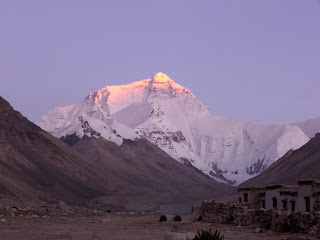
The headache is back with a vengeance. Eleanor, Genevieve and Jeff have already washed and are having breakfast. I feel like a hammer is pounding my head faster and faster as I get up. I shove some cold medicine and several vitamin C pills down my throat and grit my teeth as I get up to join the others. Over the roofs of the small houses, Qomolangma is completely covered by thick mountain fog. The sun is out, but the fog that bounces red and purple all over the surrounding mountains also hides the yellow ball - or maybe I'm just too high in the world for the sun to be out at this time.
After a breakfast of flour pancakes and butter tea, we drive the first kilometer to the base camp. Mud green tents form a large rectangle. In front of each tent are signs identifying the tents -"Happy Hotel," "Everest Hotel," "Yak Hotel," "Qomolangma Tacky Hotel" - along with rings of heavily tanned Tibetans drinking butter tea. The locals stare at us as we pass through. The base camp seems like a tourist trap for people to say that they "slept at the base camp," but I see no actual climber.
After Laba parks the car, we begin our trek to the base camp and the mountain. The clouds begin to clear as the sun rises higher. I walk up ahead with Laba to avoid scowling at everyone - the pressure of the headache is beginning to lighten, but the lack of oxygen makes talking and breathing painful, which Laba seems to do comfortably as I struggle to keep up with him. He lights a cigarette, the fumes thankfully blowing to his right and not over me.
"Laba, you're almost forty, but not only are you kicking my ass on this hike, you're also smoking," I exasperate.
"Haha, your body isn't too bad," Laba replies, blowing out a swirling whirl of smoke. "You have a headache, but you're still walking ahead of everybody else."
"How do you know I have a headache? I didn't tell you."
"You're not the first tourist that I've taken to Qomolangma."
By the fourth kilometer, we reach a small plateau. To our right a river roars, the pure water saturated by the mountain dirt. I stand up straight to breathe more deeply. Laba lights another cigarette. While waiting for Eleanor and Jeff to catch up, I browse through the pictures of Qomolangma that I have taken on my camera. How is it that the mountain looks exactly the same in my pictures no matter where I take the picture?
We reach the final checkpoint to get closer to the mountain. Unfortunately, we need yet another permit to get closer - this one costs about $1000 per person. Instead, we climb the closest prayer flag and rock stupa covered hill to gaze at Everest. The clouds have almost completely cleared save for a few lingering white strips. On a nearby rock, I see a Sanskrit phrase carved into a rock.
"Tsekey, what does this mean?" I ask.
Our tour guide walks over and glances at the script. "In Chinese, that says '六字真言 (Six True Words),' or in Tibetan 'Ah Mane Padme Hong.' It is repeated by pilgrims and all prayers to prevent pain, death and punishment, to live longer and to get rich."
"I've seen this phrase written on mountainsides and all over Lhasa."
"Yes, it is written everywhere, like ceilings, stone utensils, mountains and doors. It's like 'Ahmitofo' in Chinese Buddhism - to say it will bring it will comfort you and others, to repeat it will bring fortune and good luck."
The monastery across the guesthouse runs this business, using the income to pay for more butter to worship Buddha and more food for new guests. The only locals that visit the girls are young teenage soldiers stationed at small checkpoints along the road to Everest. The soldiers gather around the windows that let in sunlight, slapping playing cards onto the table, yelling "Wo Cao (Fuck)" or "Chi ba (Eat some)" every now and then. The guesthouse that is maintained by two teenage girls, who prepare our meals and keep the bedrooms tidy. The girls are by the other window that lets in sunlight, knotting each others' hair into tidy braids. They have worked here for about three years, taking care of travelers that come and go. Their lives remind me of my experiences as a waiter in San Francisco - they cannot travel, but the world comes to their doorsteps seeking food and shelter while it takes in the local scenery.


share on: facebook

Saturday, August 30, 2008

Concerto: Basan Part 11

The scenery along the highway to Mount Everest is simple - green fields along the road, gray green mountains in the distance with the occasional snow-covered peak, mixed blue sky with white clouds wafting towards the horizon. The car CD stereo plays amusing Indian songs that combine kindgergarten lessons with mature themes, or compliment women excessively:
"ABCDEFGHI...JKLM...NOPQRSTUVWX....YZ.... I love you."
"Lalala, lalala, you are my sonya, lalala, lalala, you are my sonya."
In the backseat, I hear Jeff softly humming the sonya song. When the ABC song is played again, Genevieve starts to sing: "ABCDEFGHI....JKML....wait a second..."
At the first checkpoint of the Mount Everest National Reserve, everyone displays their passports for the Chinese guards to inspect. Afterwards, we drive on dirt road that snakes up a mountain. Slowly we drive, slowly we climb. At the top, we stop to look out into the distance and see four of the highest mountains in the world on the horizon - Qomolangma (Mt. Everest), Kangchengjunga, Lhotse and Makalu. Qomolangma's peak hides behind clouds. Tsekey says, "That's typical...tourists have to wait usually three days, sometimes up to a week, to see the mountain clearly." Fortunately, ten minutes later, the cloud formation blocking our view of Qomolangma moves east. Tsekey says, "You're lucky." The fast winds almost knock us off the rock wall that we stand on - we all huddle back into the car and drive down the winding road.
Three checkpoints and four hours later, we finally see the peak of Qomolangma without a trace of cloud. A single star shines high above the mountain, stained violet in the evening.
At our guesthouse, I start feeling nauseous and my head starts to pound like a migraine. Is this altitude sickness? I sit closer to the firewood stove in the center of the communal room, but excuse myself to get some medicine from my bag in our bedroom. The air outside hits me like a football that bounces off my chest. I look up at the sky. I've only seen Scorpio, Sagittarius and Capricorn in my constellation books, but the sky is full of the white dots. Stars I don't remember seeing in my books appear along the Big Dipper and Casseiopeia. Star clusters and specks of galaxies are so distinct in the black background. The Milky Way rips through the night, its violet red trench cutting the poisonous tail of the Scorpio. The headache is gone, but my breathing rate is spiking. I madly take pictures, but no manual exposure, no special mode can capture that elusive Milky Way. Damn this weak digital camera.


share on: facebook

Friday, August 29, 2008

Concerto: Basan Part 10

In Shigatse, we decide to have have Indian food for a change from yak meat and yogurt rice. A few curries and naan later, we walk towards the central monastery. At the ticket booth, the old monk looks at my shorts and says I must change into pants. I ask for some cloth to cover my legs - fortunately, he finds a nice festive orange skirt with which I can wrap myself. While walking around the temple, my stomach churns uncomfortably, and run around the temple halls seeking restrooms. Damn curry. I clutch my water bottle, emptied early along the walk. Oh yes - traveller's diarrhea is torture. Unfortunately, I forgot the medicine that Yale provided in my apartment back in Beijing. Fortunately, Genevieve buys a 7-Up for me. It's amazing and magical how a bit of sweet carbonated water can calm a stomach.


share on: facebook

Tuesday, August 26, 2008

Concerto: Basan Part 9

Kamba-la Pass takes us south beyond Lhasa to an elevation of 4794 meters above sea level. Yaks eat grass in the distance, their herdsmen specks in along the horizon.
"From here," says Genevieve, "the yaks look like overgrown ants."
At Yamdrok-tso (Blue Lake), we stop for another rest. Yamdrok, Tibetan for the color blue, is one of the three largest sacred lakes in Tibet. According to mythology, the lake is a transformation of a goddess, so nobody is allowed to set foot in the waters. I guess the yaks that feed along the water do not count. A Tibetan ornament merchant woman hounds me as I hike up a little hill to get a better view of the lake. "Two for sixty" starts the merchant, dangling necklaces and brooches in front of my face, forcing me to walk around her. By the time I make it down back to the car, she yells "two for ten" in my ears.
Nangartse is a small village more than a town. Downtown is made up of two streets interseting in a T-shape, with the highway to Everest cresting the streets' outer edges. After a dinner of cheese-stuffed dumplings and rice with yogurt, we go for a walk, avoiding the skinny starving dogs that lay passed out (or dead) along the street. A few minutes later, light rain mixes with the dust-caked road, evolving into sizeable drops. We hug the building walls, the colorful banners over doors doing little to protect us from the rain.
We proceed down the street and come across a family huddling inside a fabric store. While Genevieve and Jeff take pictures, the teenagers and children inside the store look in wonder at their cameras. Genevieve hands her digital camera to a curious girl, teaching her how to press the capture button. The girl runs around the front of the store, taking pictures of the little kids eating snacks, pictures of the adults smiling in wonder at the strange little device that freezes their faces for a moment in time, pictures of old housewives with their children looking at Jeff and Genevieve, seeking money in exchange for the pictures that they are taking. I have never seen anyone so fascinated by a digital camera.
As we walk back to our hotel (which, albeit providing thick blankets for the night, offers communal concrete bunkers with holes in the ground for toilets), I hear thunder cracking the air. The rain falls harder as the clouds seem to roll and coagulate over the town faster.
"Did you see that?" Jeff asks.
"What?" I ask.
"The rocket."
"I heard thunder."
"That wasn't thunder - that was the sound of cloud-seeding."


share on: facebook

Monday, August 25, 2008

Concerto: Basan Part 8

Eleanor and Genevieve are recovering from the flight in their rooms. Jeff and I meet on the roof of our hotel, from which we look down on Beijing Road cross into Bahkgor Square. Potala Palace pierces the clouds like Pride Rock in the The Lion King. The pace of life here is as fast as that of Beijing's, but there are less people. Chinese soldiers guard intersections and march in brigades, toting Russian rifles and heavy armored shields. The monk riots that occurred a few months ago still seem to worry the government, but these soldiers instill no sense of security. I feel wariness, restlessness. Down on the street, I take a picture of a bicycler. While judging the picture on my camera's digital screen, a solider confronts me and asks to see the picture. I ask why. No pictures of the security forces may be taken, he says. I show him the picture of the bicycler, fearing for the life of my memory card. Fortunately, the background shows no rifle, no green camouflage uniform, no trace of Chinese military occupation in Lhasa. He nods his head and walks away. While on the roof of Jakhong Temple (大昭寺), Jeff took a picture of me - I didn't notice the Chinese military sniper looking down at the market behind me.
Potala Palace - the former residence of the Dalai Lama, now converted into a money-making cultural relic by the Chinese government. The steps up to the White Palace, or the Potrang Karpo, are blocked by steel gates. All stairs lead to the Red Palace, or the Potrang Marpo. Red powder dyes the packed mountain wood walls. As I climb the uneven stone stairs, I use the battlements as support, red grains and splinters accumulating on my hand. I find myself breathing heavily, and sit at the next rest bench. The others continue moving up the stairs with the tour guide. I had just come from climbing Emei Mountain - how could a little less oxygen in the air be affecting me so much?
Up the stairs behind me climbs a skinny old man in Lama monk outfit. His royal red outer cloth and orange shirt are lined with black dirt at the creases. His yellow beanie is like that of Tsongkhapa without the sideburn protectors, though worn from lack of wash. He clutches a small bag of butter, humming softly while climbing the steps one by one. He sits down next to me.
"Hello," I greet.
He nods. I wonder if he can speak Mandarin.
"Are you here to worship?" I ask.
He nods.
"I see."
He looks at me and smiles. "I prayed all the way from Qinghai," said the Lama in accented Mandarin, "to kneel in front of the Dalai Lama."
I smile. Finally a break. "But my tour guide says the Dalai Lama isn't here," I say, "In fact, he hasn't been in the palace for almost sixty years."
"Nonsense, he is here. I have butter."
"What's the butter for?"
"Are you a tourist?"
"Yes."
"Where are you from?"
"America."
"Ah! amerigha amerigha!" he exclaims. "Ok, I am rested. Let us go."
"Huh?"
He clutches my hand, forces me up, and proceeds to almost drag my body up the stairs with a vigor almost supernatural compared to his state before he sat down. As I pass by Jeff, I smile weakly, still trying to breathe. Jeff looks taken aback, his eyes moving from the Lama to our hands to my face.
"I'll see you guys up there," I say, the Lama pulling me up at an even faster pace.
Inside the chamber of the Dalai Lama, the Lama rummages his pockets and takes out two little black peas that could pass for lint. He quickly swallows one and puts the other in my hand.
"Eat," he commands.
I smell the pea. It vaguely smells of ginseng and ginger. A Lama wouldn't try to kill anyone, I think. I place the pea on my tongue and swallow. The Lama walks through the gate preventing tourists from stepping on the royal carpet and prays in front of the empty throne of the Dalai Lama, his old body flat on the ground with palms raised to the ceiling.
"What was the pill I just ate?" I ask to the man who had sat next to the Lama.
"A piece of Sakyamuni Buddha's body."
"I just ate Buddha?"
"Yes."


share on: facebook

Sunday, August 24, 2008

Concerto: Basan Part 7

The mountainpeak pierces the clouds - through the small round window of this airplane, these peaks are like icebergs in the Atlantic, hiding their weight and power under the water blanket. I wonder if any of these peaks is Everest. The plane has rows of empty seats. I find a row without any passengers and stretch out, sleeping out the last half hour before arriving in Lhasa.
When I got back to Chengdu before I left for Jiuzhaigou, my guesthouse service attendant, Mary, informed me that the Tibetan travel bureau approved our residence permits as acceptable visas to travel in Tibet. During the Olympics, the Chinese government revised all of the original rules to limit the amount of foreigners entering Tibet. Had the Chinese government not approved my residence permit, I would probably be on a bus right now, heading south to the Tiger Leaping Gorge and Lijiang. I will have to save Yunnan province for later.
The first breath off the plane catches me off guard - the dry cabin conditions and the oxygen-deficient air makes my nose bleed. I roll a tissue and shove it into my nose. The white clouds swirl in the clear blue sky like oil colors on a painter's palette. Brown-tanned guards stand with hands behind their backs, black sunglasses reflecting the sun and my tissue-stuffed nose. I feel my breathing rate increasing. I still don't feel like I'm in a place called Tibet.
Outside, a middle-aged man with a yellow shirt, gray pants and jacket, and a younger looking woman with a red hat and striped-shirt stand holding a sign bearing our names. Enter Laba, our driver, and Tsekey, our travel guide. We toss our all of our luggage into the trunk of Laba's Toyota 4500, and head towards Lhasa. Aside from the basic introductions of "My name is" and "Where did you study your English" and "Your Chinese is nice," the ride is silent. I sit with my mouth half open as we drive through this world of blue skies, green fields and black mountains.


share on: facebook

Saturday, August 16, 2008

Concerto: Basan Part 2

The plane ride is unusually quiet – I suppose everybody on this flight isn’t used to waking up early for check-in. Genevieve, my travel partner, is also asleep, tired from staying up with a few IUP students. Surprisingly, Li Yun laoshi, the education director of IUP, sat next to me for the trip to Sichuan. After an aerial Chinese breakfast of white rice porridge with ham/cucumber and mayonnaise sandwich, we reflected on the summer session in Beijing. Li laoshi confesses she misses teaching. The administrative side of education means filing paperwork and scrutinizing over teacher salaries and sick day leaves, never really any contact with the students. For this summer, I have definitely attained my goal – to improve my Chinese fluency. I am much more comfortable and confident living in China. I can survive on my own while conversing with others about everyday topics. While traveling, I wonder if I can put everything I’ve studied this summer to test.
For the remaining time on the plane, I forced Li laoshi to teach me some Sichuan dialect. The differences are not very distinct – instead of saying “wo bu zhidao” for “I don’t know,” it is “wo bu xiaode.” However, profanity is on a different aesthetic plane.


share on: facebook

Friday, August 15, 2008

Concerto: Basan Part 1

My travel itinerary is complete. Unfortunately, I have not reviewed my Chinese textbooks for the final. I’ve been passively listened to the text recordings while perusing my Lonely Planet guide – anyways, language can’t be crammed, so what’s the point of glancing through thousands of words to stuff into my short-term memory? My ideal plan is explore Sichuan province and then travel through Tibet. However, my Chengdu travel guide is arguing that I cannot be granted a travel permit into Tibet using my permanent residence permit. In case I cannot go to Tibet, I will travel south to Yunnan province, but I sincerely hope that I can get in. My hiking bag is half-packed – I’m still debating whether to take two or three pairs of boxers.


share on: facebook

Sunday, August 10, 2008

“中国加油”Cheer: 8 years in 8 hours

Every morning on the way to IUP I bike past a neighborhood park equipped for elderly ballroom dancing sessions, pick-pong matches and young late-night forbidden kisses. The red countdown board stands at the entrance informing everyone how much time is left before the opening ceremonies down to the second. I feel a surge of excitement reading "0000 days, 3 hours, 9 minutes and 53 seconds" - finally I'll see the fruit of years of preparation by China's Olympics Committee. However, the polluted sky suggests rain - where are the silver iodides that were supposed to rend Beijing's sky clear?

Jason and I take a taxi to Hardy's hutong near Yonghegong and Nanlouguxiang. Through narrow cobbleways and past stained windows we find a traditional siheyuan (four-corner roof hutong). We walk to the entrance with a row of empty imported beer bottles lined outside a window. The ambiance inside is beautiful, but I see no air conditioning machines. Two electrical fans swing its heads back and forth, weak breezes cooling sweat beads on everyone's noses. Hardy brings out a few cold beers.
"How much do you pay a month for this place?" I ask.
"1500," he replies.

As more people arrive and crowd the hutong, I escape outside for fresh air. An old man with a towel swung over his neck watches me as he cools himself with a paper fan. Untrimmed shrubs, two yellow parakeets and four red-eyed turtles surround him.
"Old man (courteously said), how long have you lived here?" I ask.
"About six months." he says.
"Only six months? You look like you've lived here much longer than that."
"Oh yes, I used to live north of here where that big building now stands. The government razed my hutong."
"Did the government give you enough compensation?"
"Meh," he chuckles, "it'll do, I suppose."
His wife brings out a bowl of green beans to snack on.

The group finally starts walking towards Ditan Gongyuan, a park about fifteen minutes away from the hutong. As we walk across an overpass, I notice the highway below is completely empty. Red and blue lights on top of police cars blink along the highway every fifty meters. I rest my water bottle and umbrella on the stone fence and prepare my camera, but a guard in full military regalia approaches me and tells me to take my belongings off the fence. "I'm just taking a picture," I say.
"Please remove it, or we will fine you." he warns. "And please don't take a picture."
"But when will I ever see Beijing's highways empty like this during rush hour?" I complain.
After staring at me for a couple seconds, he says, "Take it when there are no cars in the highway then," he instructs.
As he watches me carefully, I hold my water bottle between my legs and snap a photo. "Why are you guys here anyways? Why is this highway empty?" I ask.
"Government officials are passing through here. The officials from Austria just passed by. We cannot allow anyone to take pictures of these officials. Anyone taking photos of officials will be suspected as a terrorist."
"Did the officials from the United States pass by?"
"Yes."
While musing the thought of President Bush passing under my feet, we continue to walk to Ditan Gongyuan. Under the park gate, we see lit-up Fuwa mascots on a roller coaster made of flowers. Hardy and a few guys buy pizza and champagne from a local restaurant for everyone for dinner. After a few bites and gulps, we hurry through the park to the big TV screens. The gate to the closed TV area is already packed with people. Onlookers begin to cheer as the red countdown board next to the screen reads "5 minutes." Everyone quickly squeezes through and finds patches of grass to sit on. The TV darkens as the stadium lights go out. The drum countdown show excites everyone to yell in mixed unison, "Ten, nine, ba, qi, liu, five, si, three, er, yi..."

After Zhang YiMou's 80,000 cast show, portions of the crowd break into modest to crazy applause for various international athlete delegations. When Taiwan comes on as "China Taipei," the park breaks into cheers and claps. As soon as the camera pans to Chairman Hu, the claps die down to smatterings. When the American athletes come out, the audience goes nuts as some people swing American flags and shirts over their heads on top of fences and platforms. When the screen shows President Bush, the audience splits into claps and boos. Finally, when China's 1,600 delegation enters the stadium, the watchers all stand and roar for Yao Ming and the athletes donned in red and yellow suits (tomatoes and eggs, as my Chinese teacher calls them). As soon as Li Ning lights the scroll torch, everyone cheers as they runs toward the gate. I hear some people complain in pain about cramped legs and tired eyes. My friends invite me to a bar in Chaoyang - I refuse. Four hours of looking at a 10 by 12 TV has drained me.

On the subway back to Wudaokou, we share plans for the upcoming weeks.
"Are you going to see any of the events?" Anjli asks.
"No, I don't want to go to them," I say.
"What?? What are you going to do after your program ends?"
"I don't want to be in Beijing...I think I'll head south toward Sichuan or Tibet."
"Can you get into those areas? With the protests and disasters, will you be allowed to travel there?"
"Meh, better now than before the cultures there are China-fied."


share on: facebook

blogger templates 3 columns |