Saturday, May 29, 2010

Tea, Cha, Chai: LiveMocha!

A friend sent me a link to a random site called LiveMocha. I thought it was supposed to be some sort of online order espresso delivery site, but it turned out to be a language study site. Naturally, I have to feature it on this blog!

www.livemocha.com
It offers very comprehensive lessons for 38 languages, including Japanese, Korean, and Mandarin Chinese. (It even offers Esperanto!) I've been testing the lessons for those three languages, and have pleasantly been rewarded with grammar and pronunciation corrections. The virtual teachers' recordings sound natural, and the lessons truly build with sufficient repetitions to drill in key grammar patterns and vocabularies.

Like Lang-8, previously discussed in this blog, other members in the LiveMocha community who are native speakers of the languages you study can correct your recordings and writings - and they will. I got a response on one of my recordings in less than 5 minutes. In order to access higher level lessons, you have to accumulate Teacher Points by leaving constructive comments on other users' assignments. Pretty nifty setup.

Essentially, LiveMocha is to the Rosetta Stone as Open Office is to Microsoft Office. So far, I'm enjoying it a lot. I'm waiting for the site to roll out with lessons in Tagalog though. If you give it a try, friend me at runinmusic!


share on: facebook

Friday, May 14, 2010

Technical Intermission: Linking Blogger to Facebook

You just spent hours crafting your blog entry, resizing and arranging your pictures and changing fonts so that the world (namely, your friends) can read about your life. You've put your link in the "websites" box on Facebook in hopes that your friends will click and check in once in a while. Alas, they don't. When you upload photos of your travels on Facebook, your friends all say, "Whoa, that's so cool! Where did you take that?" And all you want to say is, "stfu. I wrote about this - go read."

Fortunately, you don't have to exclaim profanity. And no, it's not Facebook's fault that you're ignored and isolated from your social network (especially if you're in places like China - can people access Facebook in China now?) All you need to do is built a bridge that will allow your entries to be posted directly on everybody's news feed.

This way, at least your friends will be able to read the title and maybe the first few words of your entry.
So how do you do this?
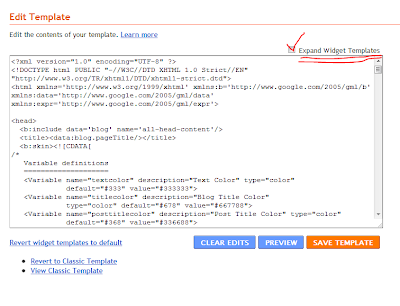
1. Under the Layout tab on the back-end of your blog, click on "Edit HTML."
2. Check "Expand Widget Templates."
3. Click inside the box with all the code, and find (by pressing Ctrl+F or Apple Sign+F) the text "".
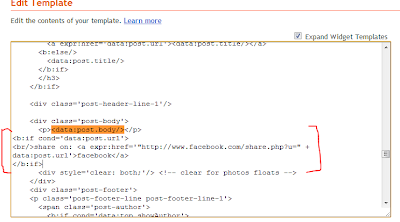
4. Right below that text, copy and paste the following bit of code:

share on:facebook
5. Click on "Save Template." View your blog. Below every entry, you should see the text circled below. Now, you can click on the blue-highlighted text to share your entry through facebook.
I hope this helps!


share on: facebook

Sunday, January 31, 2010

DigiLanguage: Using the Web

I wrote around New Year's Day on different dictionaries that I use to study East Asian Languages. The New York Times published a cool article that highlights some paid and free options to learn all sorts of languages. The BBC language site is very fun (I use it to study Polish), but here are some sites that you can use to hone your Korean, Japanese or Chinese language skills.


KBS World created this a while ago. I read and listened through the dialogues - I think this would be a great supplement to anyone studying anywhere from beginning to intermediate Korean at Yale.


Chinese Pod is great in that once you can listen and understand some of the intermediate-advanced recordings, the creators consciously select the latest vocabulary used in China and choose topics that are of immediate interest to its students. Unfortunately, it's a paid service. If you have an iTouch, you can download its recordings for a low cost.


I haven't tried this site out, but according to its homepage, all of its material is free. I'll test it over the next few days.

Happy studying.


share on: facebook

Sunday, January 3, 2010

Mad World: Chinese = Job?

My friend forwarded a very interesting blog entry called "Does learning Chinese lead to a good job in the United States? No." Though its argument creates quite a discouragement for all those who believe that Chinese language skills are an asset, it does have valid points. On campus, we often hear exciting stories of exotic escapades and wild adventures in East Asia, and dream of living it big without really understanding the opportunities created by understanding another world's culture, language and history. This entry grounds language ability in economic reality.


"I have been following Ben Ross' blog since its inception. He is an interesting chap who provided excellent insights into living in China when he worked in a Chinese barbers - long story.

His discussion on what it means for a Westerner to learn Chinese and spend three years in China is interesting. I admit I probably fall into the "wow - you speak Chinese - you must be able to walk into a high paid job".

The problem I now see clearly is that there are so many native Chinese who speak excellent English so the average westerner will never really be able to compete however much they try to learn Chinese.

This is a great quote. To most of my friends the "spouse" bit would be more than enough encouragement.

Rather than a fortune and a new career, most expats seem to return home with little more than a thicker waistline, a prodigious collection of DVD’s, and possibly a new spouse.


Ben speaks a lot of sense and shows some natural ability as an economist as he argues the case why his friend is ultimately doomed. His bleakness is refreshing (to an economist).

Ok, So you learned Chinese…Now where’s that dream job??? [Ben Ross's Blog]

Earlier this week I received an e-mail from an American friend of mine who had recently moved from China back to the US. My friend had spent three years in the Middle Kingdom, taught English, studied Chinese, and even worked a “real” job in Shanghai for half a year, and had now been back in United States for three months. His Chinese was solid, as it should be for anybody who spends three years in China, and good enough to be used on an occupational level. In his e-mail, he explained the frustration he was experiencing trying to secure a job in the United States which could build on his experience in China.

“I thought learning Chinese would be a hot commodity when I got back, and didn’t expect it would be this tough to find a job,” he expressed.

His sentiments are not out of the ordinary. In fact, the post-China unemployment funk is practically unavoidable for former expats upon their re-entry to the Western World, even in times when the economy is healthy. Part of the funk is due to the natural difficulties in transitioning back to American life. However, these frustrations are often aggrandized by high expectations, which are predicated on a fallacy that seems to follow any Westerner who has spent significant time living in China. It usually goes something like this and comes from the likes of parents, grandparents, teachers, generally anybody who is in a natural position to give you advice:

“Oh, you’re learning Chinese? China is the world’s next super-power, you know. You’ll be in high demand when you get back home.”

(Notice how people who make these comments never seem to be in the position to make use of your services. Yet they are confident others will be lining up to do exactly that.)

Chinese people provide similar, unsolicited life coaching. The line I hear most is:

你会英文也会中文。你应该做生意 。 “You speak English and Chinese. You should start a business.”

(As if that’s all it takes.)

The funny thing is that most of the people dispensing this kind of advice have never actually been in the situation which would require testing it out in the first place. They’ve never been an expat in China. And they’ve never looked for a “China job” in the US. However, they have heard all about it in the news, and they all seemingly buy into the axiom that: China is the next world superpower, and therefore there is no better way to cash in than to study Chinese.

The simple fact is however, mastery of Chinese, no matter how good you are, is NOT a golden ticket to employment in the United States.* That is, of course, unless your career goals are purely linguistic in nature (i.e. Chinese teacher, interpreter, or translator). More often than not, expats who learn Chinese and return home, find their way back into the same career (or school) path they had before they ever left for China in the first place.

Big money, international trades, product sourcing…these dreams are all in the trajectory of the scores of Tom Joads who show up annually in the Middle Kingdom. Everybody comes to China with a plan to strike it rich. Rather than a fortune and a new career, most expats seem to return home with little more than a thicker waistline, a prodigious collection of DVD’s, and possibly a new spouse. While China certainly is the current land of opportunity, capitalizing on this fact is not simply a matter of learning the language.

Although Chinese may in fact be in high demand, what’s equally important is to factor in is the supply of Chinese speakers. According to the US census, in 2006 there were 2.5 million** people in the United States who speak Chinese at home. That’s more than any language other than English and Spanish. What this means is that not even counting the hundreds of thousands of American currently studying Chinese as a second language, there are already over two million Americans, who by virtue of growing up speaking Chinese, speak the language better than you ever will, regardless of how much you study. From international traders to insurance salesmen to delivery boys at the local chop suey joint, most of the “China jobs” in the US are filled by Chinese Americans.

On the other side of the ocean, English proficiency in the Middle Kingdom is spreading like SARS in a Chinese train station during Spring Festival. Every year Chinese universities are churning out millions (literally) of graduating English majors, a large percentage of whom don’t find jobs with their bilingualness either. Those that do, tend to start out in the 1000 RMB per month range, about 170 USD. In short, there is no bottleneck in communication between China and the United States. And in a capitalist world governed by the laws of supply and demand, there is little justification for hiring an American and paying him an American wage solely because he can speak Chinese.

That being said, it certainly is possible to create a career out of your China experience, but here are some points you should consider.

-A decent “China job” is best attained by using Chinese to augment a pre-existing skill set. While the language alone won’t procure much in the way of employment, Chinese should give a competitive advantage to individuals who already have existing qualifications such as an engineering degree, a background in biochemistry, or experience in the financial sector.

-There are a substantial amount of career-oriented positions available which will make use of your Chinese skills. The thing is, most of them are in China, particularly Beijing, Shanghai, and Shenzhen. If your goal is to base your career on Chinese, you should be comfortable with the idea that you’re going to be spending the majority of your time in China.

-In order to secure a job using your Chinese, you’re going to have to be pretty good. Basic conversational skills and “knowing the culture” aren’t going to get you squat. It’s difficult to pinpoint exactly, but you should be able to sit in on a business meeting, soak up the details, and contribute to the conversation without falling too far behind. We’re talking a pretty advanced proficiency level here. Being literate helps too.

-But most importantly, finding a good China job relies much more on your actual skill set than your language skills per se. This is where people tend to kid themselves and hide behind their HSK scores. If you’re a poor communicator, disorganized, or can’t create an Excel spreadsheet, these traits are going to hurt your chances at employment much more than your inability to properly pronounce the third tone. Regard the bulk of your China job search as you would any other job search which wouldn’t pertain to your China experience. Your Chinese language chops are the gravy.

Now all of this is not to say that learning Chinese is a waste of time. Learning a foreign language, especially one spoken by 20% of the world’s population is, provides access to a wealth of knowledge and experiences unattainable to monolinguals. The ability to speak Chinese will allow opportunities for personal and intellectual growth to which it would be impossible to attach any price tag. But in terms of paying dividends measured in annual salary, the rewards of learning Chinese will likely never exceed the time and effort put into it. If you do decide devote the time and energy to study Chinese, do so out of a desire to further your own personal curiosities and intellectual development, not under the pretense that it will directly boost your career. For that, you’d be better off getting an MBA.

*I am assuming the same would apply to Canada, Australia, New Zealand, or Western Europe, but since I’ve never lived in any of those countries, I’m going to limit my direct discussion to the US.

**I’m willing to grant a significant number of that 2.5 million speak a dialect other than Mandarin (Unfortunately the census lumps all Chinese dialects together). However, current trends in immigration indicate that a) Chinese immigration to the US continues to increase and b) the vast majority of recent immigrants are proficient Mandarin speakers."
Source: http://china-economics-blog.blogspot.com/2010/01/does-learning-chinese-lead-to-good-job.html?utm_source=feedburner&utm_medium=feed&utm_campaign=Feed:+ChinaEconomicsBlog+(China+Economics+Blog)


share on: facebook

Wednesday, December 30, 2009

Schubert's Moment Musicals: A summer? A year?

(Standing in front of Tiananmen, New Year's Eve 2008).

I recently had a Google Chat conversation with a friend at Yale. For privacy reasons, I'll call him Dough. Dough studied Chinese as a Light Fellow this past summer, and was seriously considering going to China for a longer period of time. However, he asked me for advice on when and how long he should go. This summer? After I graduate? This summer and another academic year?
Dough loves all that is China, from the characters to its bicycles, from its natural wonders to its women. He is thrilled by the idea of fending for himself and carving a new identity in a foreign environment. He read my blog (yay!) and said, "I want to have the experiences you had." I am flattered.
However, Dough admitted that he participates in many extracurricular activities on campus and has friends across the classes and faculty. How could he leave everything just to study a language? He would be leaving behind friends, advisors and organizations that will need him.

Dough raised interesting concerns. He at once wanted to leave and remain in his network. Allow me highlight some of the savory bits of our discussion:

-- "I don't want to leave my friends, my campus job, my positions, etc."
Simply put, your friends and your commitments will be waiting for you when you get back. Your friends won't desert or forget about you. After talking with other alumni who had taken leaves of absences, and experiencing for myself, I found that organizations in which you were a member will want you back because you're know more globally aware and knowledgeable. However, you'll probably want to leave them and find new activities that suit your newfound tastes. Also, by being a part of society abroad, you can pursue much more interesting junior/senior research when you're back at Yale.

-- "I want to have the experiences you had."
Sorry, but you won't. I'm not saying this with any sort of pride - rather, I say it with jealousy. Your experiences will be more exciting and awesome, guaranteed. In countries as confusing, bizarre, exciting and insane as China, Japan and Korea, you can walk down a street, talk to ten different people the same question and hear widely different responses. East Asia is changing rapidly - my blog attempted to capture, in several hundred word bits, brief moments that I found amazing. I want to go back and continue being a part of the change. If I had the choice of either finishing my Yale degree or going back and submerging myself in any of those countries for another year, I'd choose the latter in a heartbeat. Unfortunately, Yale only allows leaves of absences with a maximum length of one year. I guess I'll just have to read your blog until I graduate.

-- "I had a lot of fun during summer, studying and partying."
The academic year experience can be very different. Many of your summer drinking buddies will probably go back home, and you'll have to find new ways to keep yourself occupied. You'll probably feel homesick, alone, depressed, annoyed. You'll probably complain often. (Complaining, though, is something we have to do anyways in order to learn languages.) But think of the good things: you'll experience the other three seasons. You can use your solitude to seriously reflect about your life - assuming we all will live until we're 100, you've already lived one-fifth. How will you live out the remaining four-fifths? You can build more intimate relationships with local friends. You can visit more exhibitions, participate in club events far more interesting than the ones at Yale, attend events you'd never go to - and in the process, you can begin understanding your own passions. At Yale, most people don't really allow themselves the peace and serenity necessary to find their interests.

-- "The idea of being a foreigner excites me."
Read this piece on being foreign by The Economist.

Dough, I hope you ultimately make the decision that you won't regret.


share on: facebook

Sunday, May 11, 2008

Nocturne: Mothers

At the beginning of my sophomore year, I secretly planned to stay at school until the dorms closed. After a couple weeks of hanging around with the family, I couldn’t accustom myself to the slow pace of home. College was moving, exciting. Funny how I ended up being the first person back home out of all my suitemates.

If we decided to wage a war against our moms, moms would win without using nuclear bombs or using unmanned surveillance technology. No, their strategy is much more fundamental – it attacks basic needs. Cut off the homemade food supply, let the mundane college food collect its toll. Keep communications to a minimum during exams so that your child doesn’t know how you are and cannot use you as a source of procrastination.

Surrendering wasn’t hard. No one can live without food and love.

That’s my mom – reeling me in with 돼지보쌈, 된장찌개, and the latest gossip on the antics of Korean housewives she meets at her English school (the gossip is worthy of a blog entry – stay tuned). With mouthfuls of 김치 and the assortment of 반찬 that she has prepared, all I can do is nod to her sarcastic criticisms of Korean mothers. Defeat is tasteful and enjoyable.

I found this rather touching article about single mothers in China dealing with their own set of hardships.

“When we argue that a woman owns the uterus, and it’s her right to decide whether to deliver the baby or not, people won’t buy it,” said Yuan Xin, director of psychology at the Consulting Center of Nankai University. “If you are a woman, your personal choice is monitored and supervised by a lot of others, and they expect you to do what everyone else does.”

How frustrating it must be to be a strong woman in China. If you’re trying to make yourself into a 职业女性,society calls you 女强人 or 三八。 We can all remind ourselves through the lyrical genius of Oveous Maximus:
“Picture 270 days – 270 days where bones lift and organs shift to make room in the womb for you and I the future generation ‘cuz when you’re born it’s appreciation…‘don’t cut off the hand that feeds you,’ but we do when we oppress women on so many levels, our perceptions of them less than equal…a woman’s leche is pure…pure like my mother for raising two boys single with two jobs trying to make singles just to put food on the table…the way I see it, this will always be a man’s world, under a woman’s supervision.”

Some suggestions to all Light Fellows and travelers: Get a webcam. Set up Skype for your mother and teach her how to use it so that you she can worry less about you while you’re in China. Hug her…and eat her food while you can.


share on: facebook

blogger templates 3 columns |